Maybe AI Really Can Make This the Year of Linux
Linux already ran on almost anything. The hard part was handling the exceptions. Omarchy, agents, and skills are making those exceptions cheaper to diagnose.
Every year, someone announces that this will finally be the year of Linux on the desktop. By now, the phrase works better as a joke than a prediction.
Still, for the first time in a while, I think there is a genuinely different reason to bring it back. Not because Linux suddenly found the perfect interface, every hardware vendor embraced it, or Windows made one uniquely terrible decision. The difference may be that AI and agents are lowering the cost of Linux's hardest problem: its exceptions.
Linux runs on an absurd range of hardware. Stop and think about it and it feels like a small miracle: components from different vendors and generations, laptops with peculiar firmware choices, barely documented peripheral protocols, and drivers often maintained by people who do not even own every device they are trying to support.
The surprising part is not that one combination occasionally fails. It is that almost all of them work.
But one exception can still ruin the entire experience.
The exception that decides whether you stay
For years, installing Linux came with an unwritten clause. If an update broke something, suspend stopped working, audio disappeared, or your gaming mouse exposed only half its features, you had three choices:
- learn enough to repair the system while it was running;
- live with the problem;
- go back to Windows.
The first option could turn into a pilgrimage through issue trackers, wikis, old Reddit posts, and forums written in languages you did not speak. A huge amount of knowledge was available, but locating the right fragment, proving it matched your hardware, and distinguishing a current fix from a five-year-old command was part of the job.
Windows makes the problem feel different, but not necessarily better. It hides more of the machinery and offers fewer places to intervene. When a bug falls outside the path anticipated by the vendor, waiting for an update may be the only practical option. Linux at least exposes the pieces; the catch was that you needed to know where to look.
That may be changing.
A distribution that reduces the possible states
Omarchy does not try to support every desktop, package combination, or imaginable way to configure Arch. Its promise is narrower: a curated system with decisions made in advance and a known path for updating, repairing, or returning to a stable state.
That constraint matters. Diagnosing a completely customizable system means reasoning about too many possible states. When a distribution knows its default packages, how they were configured, and how updates are applied, it can offer more predictable recovery paths. The Omarchy update documentation, for example, describes omarchy reinstall, which reinstalls the default packages, returns the machine to stable, downgrades packages that are too new, and restores the baseline configuration.
It does not prevent every failure, nor does it turn Arch into an appliance. What it provides is extremely valuable: a known baseline.
For someone who relies on the computer for work, that changes the conversation. The customization remains, but there is a reasonable answer to “how do I return to a state we know works?”
An agent that can inspect the machine
The second piece is AI, but not as a chatbot where we paste an error message and hope it guesses the missing context.
A local agent can inspect the actual environment: query journalctl, read systemd-coredump, check versions, identify hardware, inspect RAM and swap, correlate the failure with system events, and follow the evidence before suggesting a change.
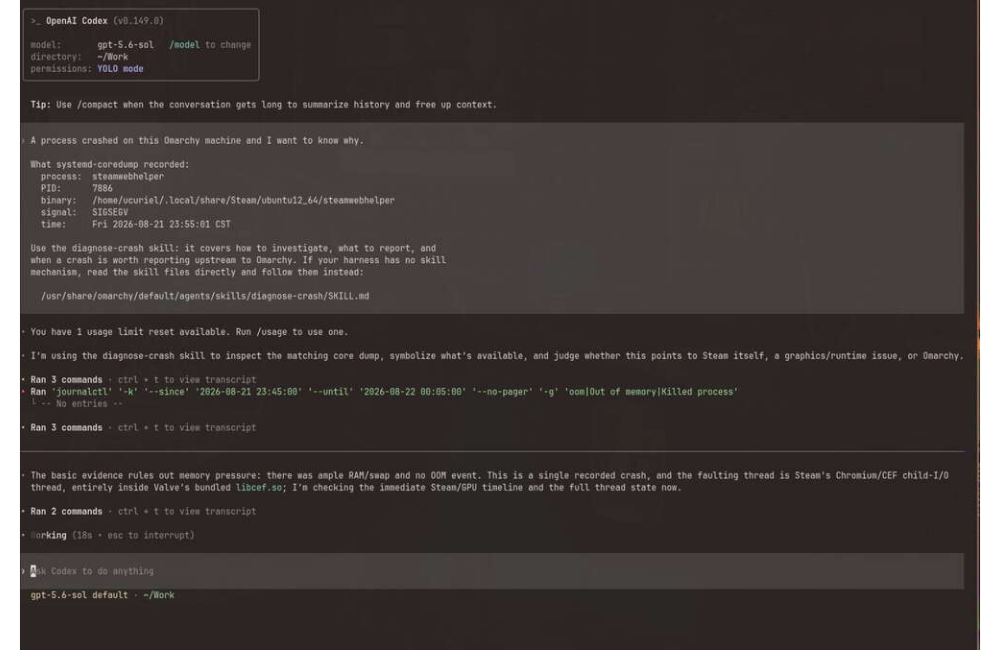
Recently, Steam raised a notification after steamwebhelper crashed on my machine. Opening it made Omarchy launch my configured agent—Codex in this case—with the process context and a specialized instruction for investigating the crash.
The agent did not jump straight to reinstalling Steam or blaming the graphics driver. It first ruled out memory pressure because RAM and swap were available and there was no OOM event. Then it located the failure inside libcef.so, on a Chromium/CEF thread bundled with Steam, and continued checking the GPU timeline and backtrace.
That is the difference between a plausible answer and a diagnosis. The AI did not need to imagine how my computer was configured. It could ask the computer.
Skills turn advice into a method
The third piece is the skills and harnesses connecting the agent to the system.
Omarchy ships crash diagnosis as a diagnose-crash skill. Its procedure explains how to establish facts from a core dump, symbolize a backtrace, decide whether the failure belongs to Omarchy or an application, and judge whether it is worth reporting. If it appears to be a real Omarchy bug, the flow searches for duplicates and asks for permission before filing an upstream report. The method works with the user's chosen agent instead of being tied to a single provider.
This looks like a small interface change—clicking a notification to open an agent—but it packages some of the knowledge that used to be scattered across the community.
A forum preserves an answer. A skill preserves a procedure.
It can also run that procedure against the affected machine, collect evidence, and adapt the next step to what it finds. It does not replace maintainers or guarantee that the diagnosis is correct. It does narrow the gap between “something broke” and “I have enough information to understand or report it.”
Open source was the piece already in place
None of this would work the same way on a completely opaque system.
Linux already provided the ingredients: detailed logs, inspectable interfaces, source code, kernel documentation, public issue trackers, diagnostic tools, and a community that has spent decades documenting unusual combinations. The kernel documentation shows the breadth of the work required to coordinate devices, buses, power, memory, and drivers. It also helps explain why no small project can test every possible combination.
AI did not create that knowledge. It offers a new way to navigate and apply it to the context of one specific machine.
Linux's transparency used to be an advantage mostly for people who knew how to interpret it. With an agent capable of reading the system, that transparency begins to benefit many more users.
My mouse is a less dramatic example
I ran into a smaller version of this problem while configuring my mouse. The available graphical tools did not expose everything I needed, and for a while I thought wireless mode did not work with libratbag at all. It turned out that support had already been fixed. I arrived ready to investigate and perhaps contribute to the repository, slightly too late to be the hero of that story.
Using that foundation, I built Ratbag Mouse, a plugin for viewing and changing profiles, DPI, polling rate, and battery state from the Omarchy bar.
The plugin does not magically make Linux support every mouse. It uses an open chain that already exists: the device exposes capabilities, ratbagd presents them through an interface, and Omarchy makes it possible to integrate them into the desktop. If one link fails, I can inspect every layer. Now I can also ask an agent to help me trace them.
That is the pattern I find compelling: not an AI floating above the operating system, but one situated inside an environment whose tools it understands and whose state it can observe.
It does not remove the risk
Giving an agent terminal access introduces risks of its own. A convincing diagnosis can still be wrong. A destructive command remains destructive even when it arrives with an excellent explanation. A poorly designed skill can automate bad practice with remarkable efficiency.
The answer is not unlimited control and optimism. We need permissions, visible evidence, a separation between diagnosis and remediation, confirmation before sensitive changes, and a reliable recovery path. In Omarchy's flow, even filing the upstream report requires consent.
A curated distribution should not be mistaken for universal compatibility either. There will still be laptops with troublesome firmware, undocumented peripherals, and regressions nobody caught before an update shipped. Hardware diversity does not disappear because a model can read logs.
What changes is our ability to respond to those exceptions.
Maybe “the year of Linux” was never about features
Linux has been fast, capable, and pleasant enough for many people for years. What held others back was not always a missing app or a prettier interface. It was the reasonable fear that something could stop working on a random Tuesday and fixing it would cost an afternoon—or require learning a second profession.
Omarchy provides a more predictable baseline. Agents can investigate the machine instead of answering in the abstract. Skills turn decades of community knowledge into processes that can be repeated, reviewed, and improved.
None of those pieces guarantees a perfect system. Together, they lower the price of having an imperfect one.
Perhaps Linux did not need to eliminate every exception to reach more people. Perhaps those exceptions only needed to stop feeling like dead ends.
Where this terminal obsession started
The Terminal as My IDE
As a back-end developer I live in the terminal. This post covers the setup that finally gave me a fast, distraction-free environment — Vim, tmux, zsh, wezterm, and a handful of tools that made it all click.